Sunday, October 29, 2006

Flow Measurement Products

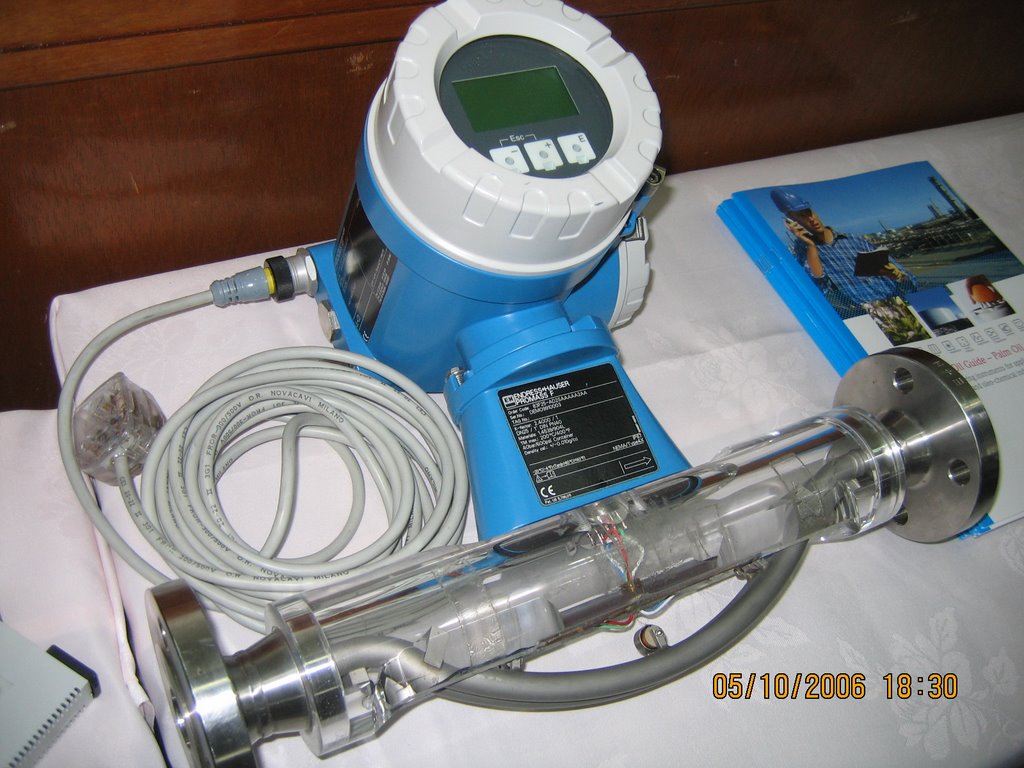
Two weeks ago I went to a half a day Endress + Hauser Biodiesel Instrumentation Seminar. I learned more about their product range there. Here I attached some of the flow measurement range product from Endress + Hauser that can be used from various range of condition. Those are the coriolis flow meters which can provide very accurate reading. Study more about the company at http://www.endress.com/.
Study more about the flow meter products HERE.
Get the Endress Hauser magazine HERE.
Learn more about other products from Endress Hauser HERE.


Friday, October 20, 2006

Turbine Regenerative Pump

What type of pump may be appropriate for a liquid near saturation, a low flow rate, and very limited NPSHa (net positive suction head available)?

This application is nearly perfect for a turbine regenerative type of pump. Factors that immediately identify your application and pump type are: the small flowrate, low NPSHa, and high temperature. The regenerative turbine was specifically developed for these conditions and one more: high discharge pressures. The high discharge pressure may not be necessary, but the regenerative turbine can give you a NPSHr of 0.5 feet with ease. They are particularly suited to saturated boiler feed water and your application is similar, albeit not in pressue. You can visit the site below to learn more about these types of pumps.
Source: Art Montemayor
Density Estimation for 2-Phase Mixture

What is a good correlation to estimate the density of a two-phase mixture that is mostly vapor or operating within the mist flow region?

Spink suggested the correlation below for qualities in the range of 0.82 to 1.0:

Adopted from Cheresources Newsletter

Wednesday, October 18, 2006

Design of Experiment for Chemical Engineering Research

For those chemical engineering post graduate students whom are doing research, or who might plan of doing research, planning your research is very important. There will be a lot of experiments to be carried out. There must be a systematic way of doing all the tonnes of experiments. And one technique to do so is by using the Design of Experiment (DOE). My wife , Mazura, and a colleague of mine, Farizul, is going to use this tool for their pH.D research. I did used this as well during my Masters by reseach work few years ago.

DOE is a very useful technique to plan our research. From DOE we can optimize the research and know all the processing parameters that can yield optimum result. So what is actually DOE?

In an experiment, we deliberately change one or more process variables (or factors) in order to observe the effect the changes have on one or more response variables. The (statistical) design of experiments (DOE) is an efficient procedure for planning experiments so that the data obtained can be analyzed to yield valid and objective conclusions.

DOE begins with determining the objectives of an experiment and selecting the process factors for the study. An Experimental Design is the laying out of a detailed experimental plan in advance of doing the experiment. Well chosen experimental designs maximize the amount of "information" that can be obtained for a given amount of experimental effort.

The statistical theory underlying DOE generally begins with the concept of process models.

Process Models for DOE

It is common to begin with a process model of the `black box' type, with several discrete or continuous input factors that can be controlled--that is, varied at will by the experimenter--and one or more measured output responses. The output responses are assumed continuous. Experimental data are used to derive an empirical (approximation) model linking the outputs and inputs. These empirical models generally contain first and second-order terms.

Often the experiment has to account for a number of uncontrolled factors that may be discrete, such as different machines or operators, and/or continuous such as ambient temperature or humidity. Continue reading the article HERE. It's a very useful and informative one.

There a re various software/packages that offer DOE. Among them are using Statistica, Design Expert, DOE Fussion. So, incase you're interested to learn them, get hold of the software. You can start learning them from the help or tutorial available in the software. But, learning by yourself is quite slow. I know because I experienced that before. It's better for you to go through and then ask somebody who knows DOE. That will be a better way of learning. But if you/or your research group have the budget, request from your boss/supervisor to go for a dedicated course to learn DOE.

Ok, to go a little bit deeper, there are a few designs that can be choose under DOE. There are Plackett Burman Design, Response Surface Methodology (RSM) and others. I used RSM before and it was very usefull. I can have a lot of analysis generated infront of me by using RSM. It's a really fantastic tool.
Tuesday, October 17, 2006

Boiler Explosion: What When Wrong? Part 2

Later the electrical and instrumentation department worked hard to dry everything at the control panel. The paint on top of the control panel were damaged and ripped off from the effect of hot caustic. The boilerman also worked hard to clean the mess and spillage in the surrounding area. The boiler was left for a while to let it cool down and dry.

Soon after about 2-3 hours, i guessed, instruction was given to start the boiler, at low fire mode, just to slightly heat up the mixture of caustic and water inside the boiler. The time was about 1430 Hrs, and I just arrived at the boiler and watching the boiler people doing their job. That was the time when the boiler exploded and produced such a terrifying sound!!

After investigation, it was found that burner A (it's a twin burner boiler), furnace backfired. The boilerman intended to run the burner at a low fire mode, but instead, without anybody realising, the burner which already contained with natural gas, straight away go to the high fire mode, which provided a big spark. That caused the explosion to occur which made the burner ripped off from the boiler body and created great damage around it. The boiler sequence actually when wrong, because of the short circuit in the control relay base from the earlier hot caustic spillage. When the short circuit occured undetected, the servo motor ignited the high fire mode, by passing the other sequence of low fire etc.

It costs a lot to repair the boiler. However, I solute our maintenance fitters, instrumentation and electrical technician, including boilerman because they work very hard to rectify and repair all the damage. Within a short period of time, about 36 hours, the burner (which was luckily can still be used) was re-attached at the boiler and all pipings, fittings, valves, gear etc was fixed back. We called some boiler expert to help us with the boiler sequence and start-up operation, and that cost some money too. Well, now the boiler is back in operation. And for sure, we'll be extra carefull from this moment to avoid similar or almost similar incident from occuring again.
I would definitely won't forget that moment. And another moral of the story, do not walk unnessarily nearby the boiler!!! Appreciate life...


Monday, October 16, 2006

Boiler Explosion: What When Wrong?

After almost one week since the small boiler explosion occured, I asked my colleague the person incharge of the boiler, what is actually the reason the boiler exploded? I asked him just now, because the complete report from the specialist have been revealed.

Ok, we had some problem of some slight oil contamination inside the boiler water/steam. This is definitely not good. It can create some fluctuations in the steam production and also can cause wet steam which will result in pressure drop. And there are a lot more reasons on the bad effect of oil being inside the boiler.

So, the chemical vendor suggested us to do the Caustic Boiling. It's a method to removed completely any traces of oil inside the boiler. So, we did it. I did mention what chemical we blended and poured inside the boiler. The chemical is supposed to be mixed and boiled inside the boiler at temperature ranging from 60 - 70 oC. The feed water temperature is already about 80oC. Our superior advised to heat up the temperature so that the caustic can be thoroughly mixed with water inside the boiler via physical boiling technique. And guess what, the man-hole is not closed.

As the temperature increased gradually, the water + chemical is now almost boiled, and the water splashed out of the boiler man-hole. The hot water + hot mixture of various caustic
came out of the boiler man-hole and flowed down the external boiler body touching and covering the boiler control panel. Luckily my colleague bravely and swiftly shut off the boiler power/panel despite knowing that he can badly injured himself if the hot caustic fell and splashed on his body!!! Immedietly the electrical and intrument department were called to safe the control panel by drying it to avoid wire/electrical shot later.

Sunday, October 15, 2006

Colarado Underground Black Gold Questionmark?

On my previous post on the 4th of October 2006, I mentioned about why are we busy cracking our head to think of how to process, produce and commercialize vegetable oil as a renewable energy to replace the fossiel fuel. I met and discussed this matter with an American who happens to be a Endress + Hauser Manager who came to Malaysia conducting some training and seminar, 2 weeks ago.

He said the fact is correct. However, it is very difficult to get the oil from the shale. It may took some super technology to dig and get the oil. It may also take perhaps another 50 years to get the oil underneath Colarado!!! I don't know, this was what the guy said.

I asked my colleague who is a petroleum engineer about the issue. He said, oil inside a shale is very difficult to obtained due to the complexity of the earth/stone structure. The area which have oil is very porous and makes digging the oil very tough. About two years ago, when were having a chat, he said that the fossiel fuel reserve is so big down there. The problem is that the present technology to dig the oil is not there yet. We can only get the oil which is easy to dig!!! Therefore, the oil and gas sector need a more advance method and technology to produce oil which is still available.

And perhaps, in the mean time, the crops can help to ease the pressure of limited energy supply / resources, via biofuel / biodiesel. So, now my paradigm had shift again. Vegetable oil is important to support the energy demand, not replacing them.