Sunday, November 12, 2006

Novel US ‘Super Boiler’

As a person who uses the steam from boilers regularly, I found out about this article/news from the "engineerlive.com/european-process-engineer" newsletter. It's an interesting and very good innovation that I think i better share it with the rest of you. Those who operate or who'se close to boiler operation may found this interesting, i guess....

An Illinois-based organisation dedicated to research, development and training for the natural gas industry has developed a new industrial steam generation system that provides increased efficiency, reduced emissions and lower fuel costs.

Gas Technology Institute (GTI) has teamed with Cleaver-Brooks-a leader in packaged boilers for industrial, institutional, and commercial applications-to focus efforts on bringing technological advances to the marketplace.

a) The super boiler. Two-stage 90HP lab boiler (b)Transport membrane condenser at specialist rubber site (c) Humidifying air heater at specialist rubber site.

Smaller footprint

Now in field demonstration at Specification Rubber Products in Alabama, the advanced

gas-fired boiler-dubbed the ‘super boiler’ by its sponsors-has shown significant performance improvements over alternative technologies.

In addition, the boiler has a 40percent smaller footprint and half the weight of conventional boilers.

Read more here http://www.engineerlive.com/european-process-engineer/16618/field-tests-begin-on-novel-us-super-boiler.thtml

Saturday, November 11, 2006

Determining if a pipe is running full or is at its sealing flowrate?

How can one determine if a pipe is running full or is at its sealing flowrate?

The following equation gives a quick check to determine the sealing velocity for a pipe:

Q = 10.2 D^2.5

where:
Q is the liquid flowrate in gallons per minute
D is the pipe diameter in inches

If the current flowrate in the pipe is less than the value calculated for Q above, then the pipe is below its sealing flowrate or is said to be partially flooded. In order to calculate the velocity in this pipe you must use a set of flow area equation presented in Chemical Engineering magazine (March 1998, p. 129). The above equation is valid for liquid flow through a horizontal pipe.

Adopted from http://www.cheresources.com/chexpress/chexpress28.shtml

Taking Care of a Physical Refinery Plant

The pass 2 weeks was a very tough for me at work. And it's not going to end. This is just the beginning. A major part of my job is to take care a very big physical refining plant, with a capacity of 3000MT/day running 24 hours for about 355 days a year together with a very experience senior production executive. Another major part of my job is to take care of quite a number of projects and utilitiy jobs inside the factory. This consume a lot of my time and as a result, my duty and time for plant is not much. I always depend on my senior colleague when it comes to the plant matter. I just started co-taking care of the plant with him for about 1.5 years now.

My worse night mare have come. My senior colleague was offered a very good job and position elsewhere. The payment is damn good too. And for that, I guess, I'm going to take care the plant alone. I really don't mine taking care of the plant if I have all the knowledge and skill to control and take care of the plant. The problem is that the knowledge and skill is still not sufficient for me to take care of the biggest physical refining plant in south johor alone. I need some assistance. Between last week and this coming week, I'm racing against time to learn as much as possible everything in detail about the plant from the senior production executive. It's a very big plant. It's a very fast plant. It's a very damn important plant. I cannot effort to make any mistake in delivering instruction to my subordinates or controling the plant. I have to be 24 hours alert of what's happening to the plant because the plant is running 24 hours.

This job might look simple for those who're already experience. But for me, I'm still considered new and fresh to this plant although I know and can understand the theoretical part of the plant.
Well, I have to face this challenge. I have no choice. There're not other people to fit in here. I'm going to face it...wish me luck..you guys...pray for me....God help me....

Thursday, November 9, 2006

TYPES OF STEEL

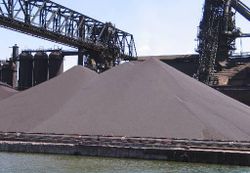
Iron ore pellets for the production of steel

CARBON STEEL Steels containing 0.2% C to 1.5% C are known as carbon steel. They are of three types.

Low Carbon Steel: It contains 0.2% carbon.
Uses: Sheets, wires, pipes.

Mild Carbon Steel: It contains 0.3% to 0.7% carbon.
Uses: Rails, boilers, plates, axles, structures.

High Carbon Steel: It contains 0.7% to 1.5% carbon.
Uses: Surgical instruments, razor blades, cutlery, spring.


STAINLESS STEEL
It contains 14% to 18% chromium and 7% to 9% nickel.
Uses: Car accessories, watch case, utensils, cutlery, pipes.


Iron-carbon phase diagram, showing the conditions necessary to form different phases


ALLOY STEEL
There are three types of alloy steel.

Mn-Steel: It contains 10%-18% Mn.
Uses: Rail tracks, armor plate, safe.

Si-Steel: It contains 1% to 5% Si.
Uses: Permanent magnet.

Ni-Steel: It contains 2% to 4% Ni.
Uses: Gear, shaft, cable.


Adopted from http://www.citycollegiate.com/IX_steeltypes.htm
Read more about interesting steel from Wikipedia HERE

Tuesday, November 7, 2006

Helicopter Crash - Tapis B Offshore Platform

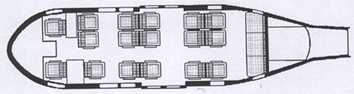
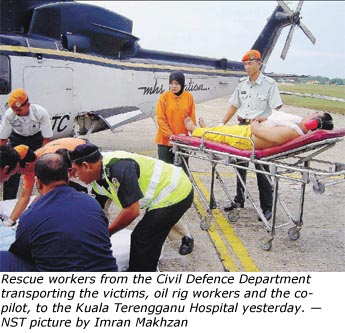
The helicopter crash at offshore Trengganu (while attempting to land at Tapis B Platform in a storm) last Sunday (5/11/2006) really caught my attention. It was a Super Puma helicopter which tranported 19 passengers + 2 pilots (The pilot did not survived). I still remember being on a Super Puma when i travelled offshore long time ago. I did not favour being inside a Super Puma. My friend, Tom, also prefers not to travel in it. We don't feel comfortable being in it. The control, maneuver and stability is the main reason. I rather choose to be in a Sikhorsky 60 or Sikhorsky 76. Well, that was long time ago. But the importance of the "Helicopter Under Water Escape Training" is really vital for this situation. It also reminded me that being in the oil and gas - offshore industry is fun, interesing, challenging and sometimes dangerous.

Read the news of the incident HERE. and also another one from VerticalReference.com
Read some news about it from Bernama.
Read news from NST.com


OSEA 2006 Conference

GAS RECOVERY – THE GOOD, THE BAD & THE UGLY

Gas has always been difficult to handle when discovered, both on land and offshore. You can't put it in a barrel or a tank. You had to have a market and a pipeline. But not any more.

Not with the evolution of new technology such as conversion methods to liquefy the gas - GTL, LNG, methanol, or the development of approved CNG carriers. Putting such equipment onto FPSO-type vessels could be the solution to all the stranded gas around, not just in Asia, but around the globe wherever gas fields are found. Sometimes it might even be cheaper to pipe gas back offshore for compression, rather than run expensive pipelines around protected areas. This is a solution looking for a problem. The future is now.

Here's your chance to take a long-awaited look at the techniques and technologies available to recover stranded or uneconomical offshore gas reserves at the OSEA2006 Gas Recovery Conference!

Hear from the experts as they debate the pros and cons of various gas recovery methods at the Roundtable • Which method is likely to be the most expensive? • Most efficient in terms of total recovery? • Most difficult to install and maintain? • What are the relative weaknesses and strengths of the different systems? • What is the time scale for implementation of each? • To buy or to lease? What are the life span and long range economics?

Have all your burning questions answered at the interactive Q&A sessions!

PLUS! Don't miss out on the other two conferences focused on Upstream and Production technologies.


SCHEDULE-AT-A-GLANCE
Preview the Schedule-at-a-Glance, conference topics and speakers at www.osea-asia.com/Conference_Programme.htm

LIMITED SPEAKING OPPORTUNITIES
If you're still interested in presenting a paper at the conference, please email cs@sesallworld.com with your proposal.

CONFERENCE REGISTRATION
Visit www.osea-asia.com/registration.htm to secure your seat today or contact the Conference Team at Tel: +65 6233 8622,
Email: cs@sesallworld.com

Seats are filling up fast! Sign up for the OSEA2006 Conferences today to avoid disappoint.

CONNECT WITH MAJOR PLAYERS ACROSS THE OIL AND GAS VALUE CHAIN AT THE CONCURRENT OSEA2006 EXHIBITION

• View the hottest new technologies from over 800 companies, coming from more than 48 countries

• See pavilions from Australia, China, Germany, Italy, Norway, UK and USA

• Meet more than 10,000 industry and business professionals from over 60 countries

• Network with market leaders at the OSEA Networking Night and Golf Tournament

Click here to pre-register for the exhibition.
Monday, November 6, 2006

Hot Water System Problem

Few weeks ago, our specialty chemical vendor from Nalco came and performed his routine water testing in one of the plant in my factory. He was testing the hot water tank system and found out that the water pH was below 6. The pH is supposed to be control at about 8. Other chemical parameters seems to ok and within normal range. So, he added some caustic solution into the hot water system to increase the pH. He also advised us to dispose half of the water inside the system and introduce fresh water. He gave me a copy of the report and told me the situation.

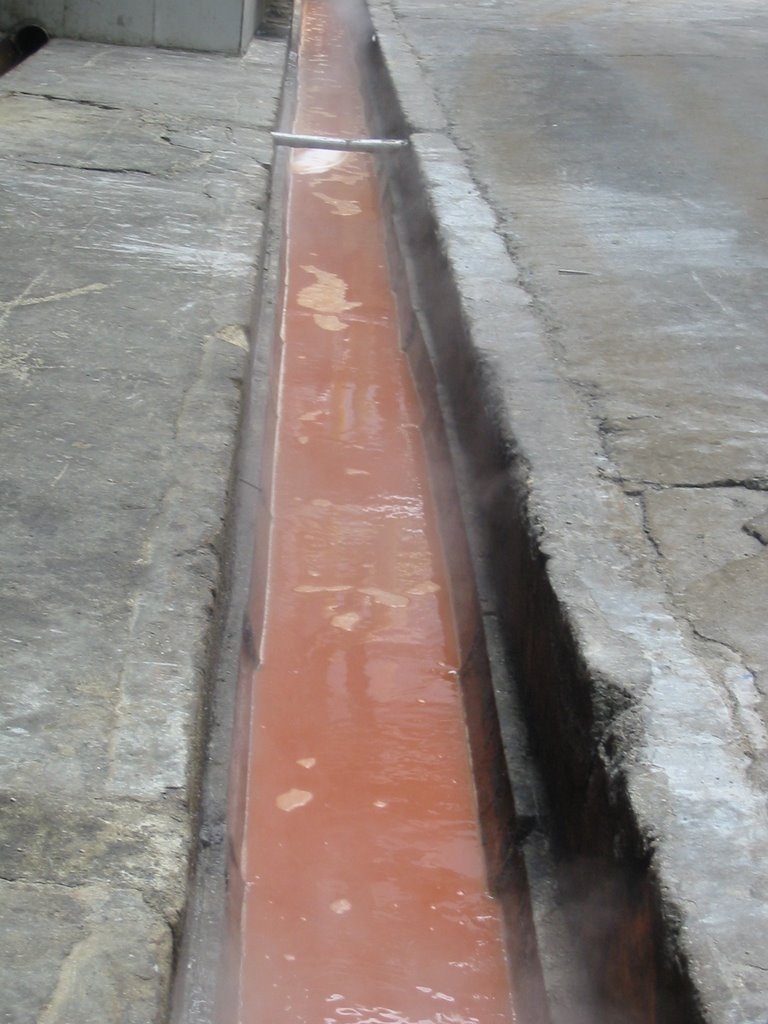
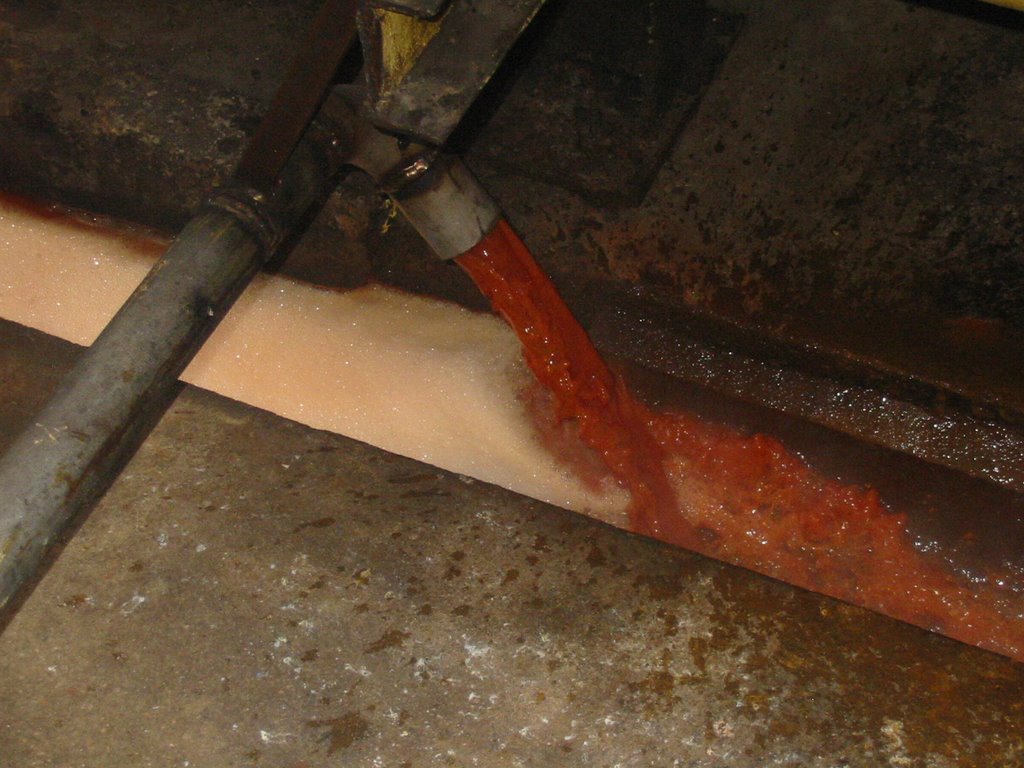
Later, the same day, a supervisor from the above mentioned plant was instructed to flush/blowdown the water in the hot water system. As soon as he opened the final valve, a red hot colour water came out from the system. We were surprised with the colour of the water! My bos who saw the water colour immedietly thought a severe corrosion is taking place inside the system. I went to the site at observed, took some photos and took some sample as well.

From my previous experince, i know that, if corrosion really takes place, the iron which is heavier will sediment on the bottom of the sample bottle. I waited for one day and the next day, i found out that the water is still in the same state and colour. No changes can be observed from the colour. This is a very homogeneous solution and i believed that this is not corrosion. It was something else.

So, I waited for the test result which the chemical vendor carried out. Later, the following day, he emailed me the report and the result showed that iron is undetected!!! So, first conclusion ---> no corrosion is taking place.

Later we realised that the red colour water is actually a product of a chemical reaction inside the hot water system. When the chemical vendor poured in some caustic solution to increase the pH, the solution actually reacted with some oil inside it. We are still not sure which type of oil (Lab test indication). But, this shows that one or more heat exchanger in the system is leaking.
So, second conclusion ---> One or more heat exchanger is leaking and therefore, the plant personel must detect which heat exchanger is leaking and isolate them.